Quick answer
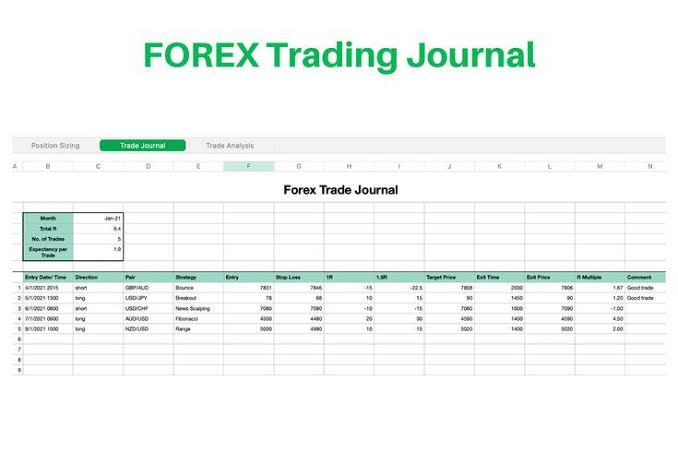
- A forex trading journal template should capture trade facts (entry, stop-loss, lot size, outcome), your reasoning for entering, and your emotional state.
- Log every trade immediately — before, during, and after — so details stay accurate and you catch sizing errors in real time.
- Review your journal weekly: calculate win rate, average R-multiple, and expectancy, then turn your most frequent mistake into a written rule.
In this article
- What Is a Forex Trading Journal and Why Does It Matter?
- What Should You Record in Every Journal Entry?
- Step-by-Step: How to Fill In the Template After Each Trade
- Free Forex Trading Journal Template You Can Copy
- How to Review Your Journal and Spot Costly Patterns
- Common Mistakes That Make a Trading Journal Useless
- Quick-Start Checklist: Your First Week of Journaling
- Frequently asked questions
What Is a Forex Trading Journal and Why Does It Matter?
A forex trading journal is a structured record of every trade you take — capturing not just the numbers but also why you entered, how you felt, and what you learned. Think of it as a personal trade log spreadsheet that pairs hard data (entry price, stop-loss, lot size, outcome) with the soft data no platform tracks for you: your reasoning, your emotional state, and your post-trade review.
Many beginners confuse a journal with the trade history log inside their broker’s platform. That history shows what happened — pairs traded, open and close times, profit or loss. A proper forex trading journal adds why it happened. It records your setup rationale, whether you followed your plan, and the lesson each trade taught you. Without that context, a list of wins and losses is just noise.
Journaling is a risk-management tool, not paperwork. When you review your journal consistently, you spot the repeated mistakes that quietly drain your account. Here is a concrete scenario:
Example: A trader logs 40 trades over a month. During the weekly review, she filters by the “market conditions” column and discovers that 28 of her 40 losses — 70% — came from trades opened within 15 minutes of a high-impact news release. Without the journal, she would only see a rough losing streak. With it, she sees exactly which habit to fix: stop trading the first 15 minutes around news events.
This kind of pattern recognition is why journaling is not only for beginners learning how to keep a forex trading journal. Professional traders at proprietary firms and fund managers use detailed trade logs to audit strategy performance, flag emotional decision-making, and refine edge over hundreds of trades.
The bottom line: a forex risk management journal turns hindsight into a system for improvement. Every entry you skip is a lesson you lose.
What Should You Record in Every Journal Entry?
Every journal entry should capture the facts of the trade, your reasoning, and your emotional state so you can review all three later. Below is a complete field-by-field list showing what to write in a trading journal and why each piece matters.
- Date and time — lets you spot patterns tied to specific sessions (London open, news releases).
- Currency pair — tracks which pairs give you the best and worst results.
- Direction (buy or sell) — reveals whether you perform better trading with or against the trend.
- Entry price — the exact price at which your order was filled.
- Stop-loss — the price level where your trade closes automatically to limit loss. Recording it proves you had a plan before entering.
- Take-profit — the price level where you plan to lock in gains.
- Position size (lots) — the volume of the trade. Logging it helps you check whether you sized correctly for your account.
- Risk in dollars or naira — the actual money you stood to lose if price hit your stop-loss. This is the foundation of your forex risk management journal.
- Reason for entry — the specific setup or signal that triggered the trade. Without this, you cannot later judge whether your strategy actually produces profitable trades.
- Screenshot — a chart image at the moment of entry captures context no number can.
- Outcome (pips and money) — the final result after the trade closed.
- R-multiple — your outcome divided by the amount you risked, so you can compare trades fairly regardless of size. A value above 1 means you made more than you risked; below 1 means you made less.
- Emotions and confidence level (1–5) — reveals psychological patterns such as revenge trading or fear-based exits.
- Post-trade notes — anything you would do differently next time.
Example: You risk ₦10,000 on a GBP/USD buy. The trade closes at +30 pips, earning ₦25,000. Your R-multiple = ₦25,000 ÷ ₦10,000 = 2.5R. A different trade risking ₦50,000 that earns ₦50,000 is only 1R. The R-multiple makes the first trade the better-quality win, even though the second earned more money. You can use our risk-reward calculator to work out these ratios before you enter.
The most common mistake that makes a forex trade log spreadsheet useless: recording only wins or skipping the reason for entry. If you do not log why you entered, you have no way to tell whether a profit came from skill or luck — and no way to fix what caused a loss.
Step-by-Step: How to Fill In the Template After Each Trade
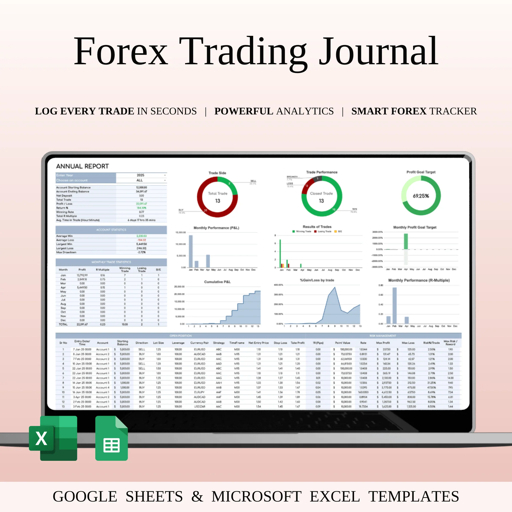
Fill in your forex trading journal template in five steps — before, during, and after each trade — so every decision is captured while the details are fresh.
- Before you enter — write the plan. Record the currency pair, your setup name (e.g., “London-session breakout”), the reason you want to take the trade, and your planned entry, stop-loss, and take-profit prices. This forces you to have a clear plan before risking money. Common mistake: entering the trade first and journaling later from memory, which lets you rewrite history.
- At entry — record actual numbers. Log your real entry price, the spread you paid, your position size in lots, and your dollar or naira risk. Actual numbers often differ from the plan. Common mistake: guessing your position size instead of calculating it properly.
- While the trade is open — note every adjustment. If you move your stop-loss, take a partial close, or add to the position, write what you did and why. This tracks your discipline. Common mistake: not logging stop-loss moves that quietly widen your risk.
- After close — capture the result and the lesson. Record the exit price, result in pips (the smallest price move a pair can make), result in money, the R-multiple (profit or loss divided by the amount you risked), and one thing you learned. The lesson field is the most valuable part of any forex trade log spreadsheet. Common mistake: writing nothing when the trade was a loss — losses teach the most.
- Weekly review — tally the stats. Add up your win rate, average R-multiple, your most frequent mistake category, and write one rule to improve next week.
Example: You have a $500 account and risk 2 % ($10) on a EUR/USD long. Planned entry: 1.0850, stop-loss: 1.0830 (20 pips away). You open 0.1 lot, where each pip ≈ $1, so 20 pips × $1 = $20 risk — that is 4 %, double your rule. Logging this at Step 2 catches the error before the trade closes.
Free Forex Trading Journal Template You Can Copy
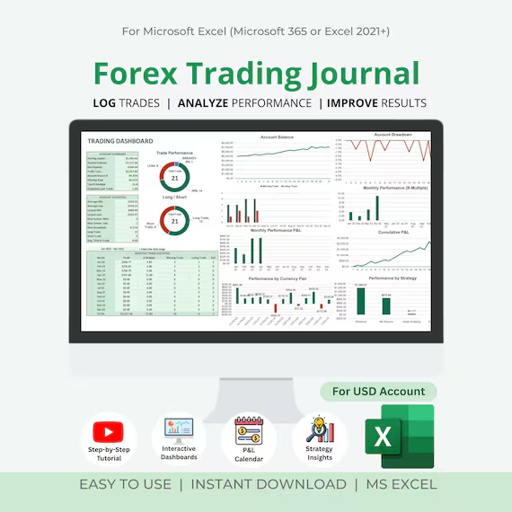
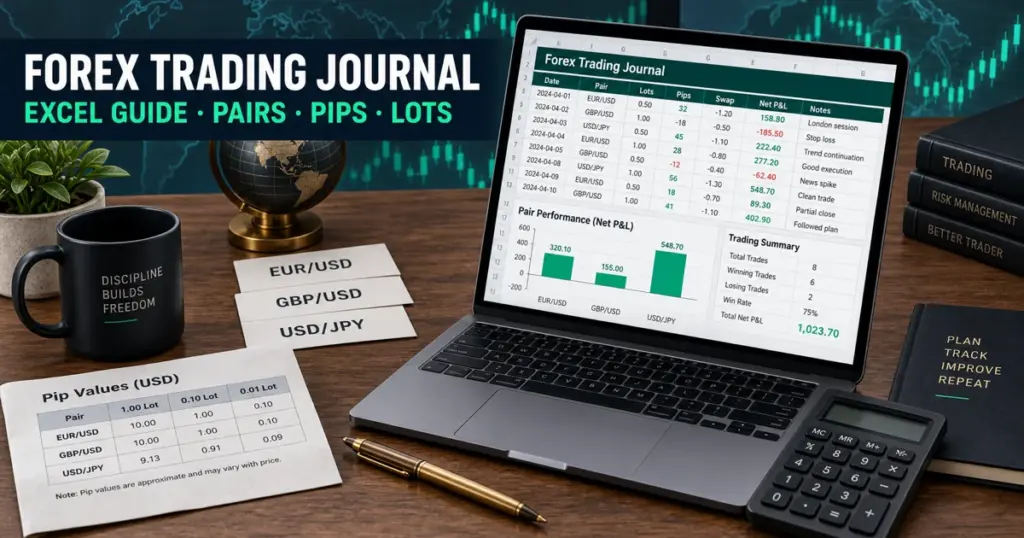
Here is a free trading journal template you can copy into Google Sheets, Excel, or draw in a physical notebook — no special software needed.
| Date | Pair | Direction | Entry | Stop-Loss | Take-Profit | Lot Size | Risk (% of account) | R:R | Result (pips) | P/L ($) | Setup | Emotion Before | Mistake? | Screenshot |
|---|---|---|---|---|---|---|---|---|---|---|---|---|---|---|
| 2025-06-09 | EUR/USD | Long | 1.0850 | 1.0820 | 1.0910 | 0.10 | 1% | 1:2 | +60 | +$60 | Bullish engulfing at support | Calm | None | Link |
| 2025-06-10 | GBP/JPY | Short | 193.50 | 194.00 | 192.00 | 0.05 | 1% | 1:3 | −50 | −$25 | Break-and-retest of trendline | Anxious — revenge trade | Moved SL wider | Link |
R:R stands for risk-to-reward ratio — the potential profit divided by the potential loss. You can quickly calculate yours with our risk-to-reward calculator. Stop-loss is the price at which your broker automatically closes a losing trade to cap your loss.
To copy this forex trade log spreadsheet, open a new Google Sheet (or Excel file), paste these column headers into Row 1, then fill one row per trade. On paper, rule the same columns across two facing pages of a notebook.
You can also build this template in Notion or any note-taking app that supports tables. Dedicated trading journal apps exist too — some are free — though a simple spreadsheet works perfectly for most beginners.
The best free trading journal template is the one you actually open after every trade. A fancy layout you ignore is worth less than a plain notebook you fill in daily. Pick the format you will use consistently, and start with the two example rows above as your guide for what to write in a trading journal.
How to Review Your Journal and Spot Costly Patterns
Reviewing your journal once a week is the single most effective way to find repeated mistakes before they drain your account. A weekly review means you catch errors after a handful of trades, not after dozens. If you wait a full month, one bad habit can compound across 20 or more trades before you even notice it.
Follow this weekly review process:
- Sort trades by outcome. Separate winners from losers so you can study each group on its own.
- Group by strategy or pair. You may discover a strategy works on EUR/USD but fails on GBP/JPY, or that one setup consistently underperforms.
- Calculate your win rate. Win rate is simply the number of winning trades divided by total trades, expressed as a percentage.
- Find your average win and average loss. Add up the dollar gains, divide by the number of winners. Do the same for losses.
- Calculate expectancy. Expectancy tells you how much you can expect to make (or lose) per trade on average over time.
Example: You took 20 trades this week. 11 won (win rate = 55%), 9 lost (loss rate = 45%). Average win = $42. Average loss = $35. Expectancy = (0.55 × $42) − (0.45 × $35) = $23.10 − $15.75 = $7.35 per trade. A positive expectancy means the strategy is profitable over time at this performance level. You can use our risk/reward calculator to check the break-even win rate for any setup.
Next, identify your top three mistake categories. Read the “Mistakes / Notes” column of every losing trade and tally recurring themes — for example, “entered without confirmation,” “moved stop-loss,” or “oversized position.”
Turn a pattern into a rule. Suppose you find that moving your stop-loss wider caused 60% of your largest losses. Your new written rule becomes: “Never widen a stop-loss once the trade is live.” Write this rule at the top of next week’s journal page and grade yourself on it every session.
This is how to review your trading journal in a way that actually changes behaviour — not just records it.
Common Mistakes That Make a Trading Journal Useless
A forex trading journal becomes useless the moment you fill it in carelessly or skip the review step. Here are five mistakes that turn a valuable tool into busywork.
- Mistake 1: Only journaling winning trades. Cherry-picking winners hides the repeated errors that actually drain your account. Losing trades contain the most useful data. Fix: Log every single trade, win or loss, with the same level of detail.
- Mistake 2: Writing vague entries like “looked good.” An entry that says “looked good” tells you nothing when you review it weeks later. You need specific reasons tied to your strategy rules — for example, “price rejected the 1.0850 support level on a bullish engulfing candle, matching Rule 2 of my plan.” Fix: State the exact setup name, the rule it matched, and one concrete market observation.
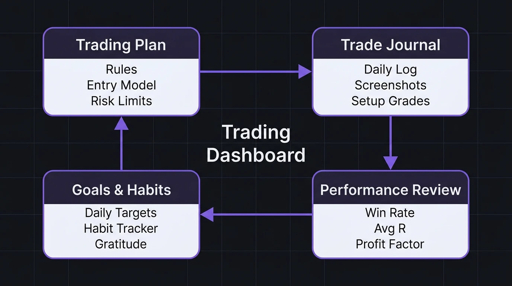
- Mistake 3: Never reviewing the journal. Writing without reading back is just data entry, not learning. The whole point of how to keep a forex trading journal is the review loop described in the previous section. Fix: Schedule a 20-minute weekly review and mark it on your calendar.
- Mistake 4: Changing your template every week. If your forex trade log spreadsheet looks different every week, you cannot compare data across months. Consistency is what makes patterns visible. Fix: Pick one template, commit to it for at least 30 trades, and only adjust columns after a full review cycle.
- Mistake 5: Not recording position size or risk amount. Without these numbers you cannot measure whether your risk management is consistent. A trade risking 5% of your account and a trade risking 0.5% are completely different decisions, even if the setup looks identical. Fix: Record your lot size, dollar risk, and percentage risk on every entry — use a position size calculator so the numbers are accurate before you enter the trade.
Every one of these mistakes has the same root cause: treating the journal as a chore instead of a diagnostic tool. Fix these five habits and your free trading journal template will actually start paying you back in better decisions.
Quick-Start Checklist: Your First Week of Journaling
- Choose your format and build the template today. Pick a spreadsheet, a dedicated app, or a paper notebook — whichever you will actually open every day. Set up every column from the template in this article (pair, date/time, direction, lot size, entry, stop-loss, take-profit, R-multiple, setup name, screenshot link, emotion tag, outcome, and post-trade notes). A forex trade log spreadsheet in Google Sheets works well because you can access it from your phone.
- Fill in the pre-trade section before you click “Buy” or “Sell” — every single trade this week, no exceptions. That means writing the pair, your setup name, planned entry, stop-loss, take-profit, lot size, and your emotional state before the trade is live. If you skip this step even once, the habit breaks.
- Complete the post-trade section within 10 minutes of closing each trade. Record the actual exit price, the outcome in pips and currency, the final R-multiple (reward divided by risk), and a one-sentence note on what you did well or poorly. Waiting until the evening lets memory fade and emotion distort what happened.
- On Sunday, review the full week. Count your total trades, calculate your win rate (wins ÷ total trades × 100), and find your average R-multiple. Then scan every “post-trade notes” column and look for the one mistake that appears most often — for example, moving your stop-loss further away, or entering without a setup. You can use our risk-reward calculator to double-check your R-multiples during this review.
- Write one specific rule for next week based on that mistake. A vague goal like “be more disciplined” does nothing. A specific rule does — for example: “I will not move my stop-loss after entry on any trade.” Tape it above your screen or pin it to your phone’s home screen.
Complete all five steps and you will have a working forex risk management journal by Day 7 — with real data to improve on in Week 2.
Frequently asked questions
What is the simplest forex trading journal template for beginners?
A spreadsheet with 14 columns: date, pair, direction, entry, stop-loss, take-profit, lot size, risk percentage, risk-to-reward ratio, result in pips, profit or loss, setup name, emotion, and mistakes. Start with Google Sheets or a ruled notebook. The risk is overcomplicating the layout and then abandoning it entirely.
How many fields should a trading journal have?
The article lists 15 essential fields covering trade facts, reasoning, and psychology. You can start with fewer, but skipping the reason-for-entry or emotion fields removes the context that separates a useful journal from a basic broker history log. The main mistake is logging only numbers without the why.
Should I use a spreadsheet or an app for my trading journal?
Either works. A spreadsheet like Google Sheets is free, fully customisable, and familiar to most beginners. Dedicated apps may offer automated imports and charts. The real risk is switching tools constantly instead of building a consistent logging habit. Pick one format and stick with it.
How often should I review my forex trading journal?
Review once a week. A weekly review lets you catch repeated mistakes after a small batch of trades instead of letting a bad habit compound across dozens. During the review, calculate your win rate, average win versus average loss, and expectancy, then write one rule to improve the following week.
Risk warning: Forex and CFD trading carries a high risk of losing money and is not suitable for everyone. This article is for education only and is not financial advice. Never trade money you cannot afford to lose.