Quick answer
- Risk only 1–2% of your account per trade and use correct position sizing so a single loss never threatens your drawdown limit.
- Set a personal daily loss cap at roughly one-third of the firm’s allowed daily loss limit to survive bad sessions.
- Stop trading or reduce to minimal size once you hit the profit target—extra trades add risk with no extra reward.
In this article
- What Is a Prop Firm Challenge and What Are You Actually Being Tested On?
- Step-by-Step: How to Pass a Prop Firm Challenge
- How to Size Your Trades So You Never Blow the Drawdown Limit
- What Are the Biggest Mistakes That Fail Prop Firm Challenges?
- A Daily Checklist to Stay on Track During the Evaluation
- After You Pass: What Happens With a Funded Account?
- Is a Prop Firm Challenge Worth the Fee?
- Frequently asked questions
What Is a Prop Firm Challenge and What Are You Actually Being Tested On?
A prop firm challenge is a paid evaluation where you trade a simulated account and must reach a set profit target without breaking strict loss rules. If you pass, the firm gives you access to a funded account with real capital, and you keep a share of the profits. The fee you pay upfront covers the cost of the evaluation.
Most challenges use a two-phase structure. In Phase 1 you face a higher profit target — often around 8–10% of the account size. In Phase 2 the target drops — commonly to 4–5%. Both phases enforce a maximum drawdown (the largest total loss allowed from your peak balance) and a daily loss limit (the most you can lose in a single trading day). Breach either limit and you fail immediately.
Example: You enter a $100,000 evaluation with an 8% profit target and a 10% max drawdown.
Profit goal = $100,000 × 0.08 = $8,000.
Maximum loss allowed = $100,000 × 0.10 = $10,000.
You must earn $8,000 before you lose $10,000 from your highest account balance.
The real test is risk discipline, not spectacular gains. The firm already knows profitable strategies exist. What it needs to confirm is that you can follow prop firm drawdown rules day after day without blowing the account. Consistency and capital preservation matter more than any single winning trade.
The most common mistake — and the fastest way to fail — is treating the challenge like a consequence-free demo account. Traders open oversized positions on day one, hoping to smash the target quickly. One bad session wipes out half the drawdown buffer, and the rest of the evaluation is spent trading scared or revenge-trading. A solid understanding of prop firm challenge rules before you start keeps this from happening.
Step-by-Step: How to Pass a Prop Firm Challenge
- Read every rule before you place a single trade. Open the firm’s challenge page and write down the profit target, time limit, maximum overall drawdown, daily loss limit, restricted instruments and any weekend-holding or news-trading restrictions. The daily loss limit is the most money you are allowed to lose in one calendar day; breach it once and the challenge ends immediately. Common mistake: skimming the rules and assuming every firm works the same way. Prop firm challenge rules explained differently by each provider, so always verify.
- Write a trading plan before you go live. Name the exact setup you will trade (for example, a pullback to the 20 EMA on the 1-hour chart), your entry trigger, your stop-loss method and your risk per trade — 1% to 2% of the starting balance. A written plan removes guesswork and keeps you consistent across dozens of trades.
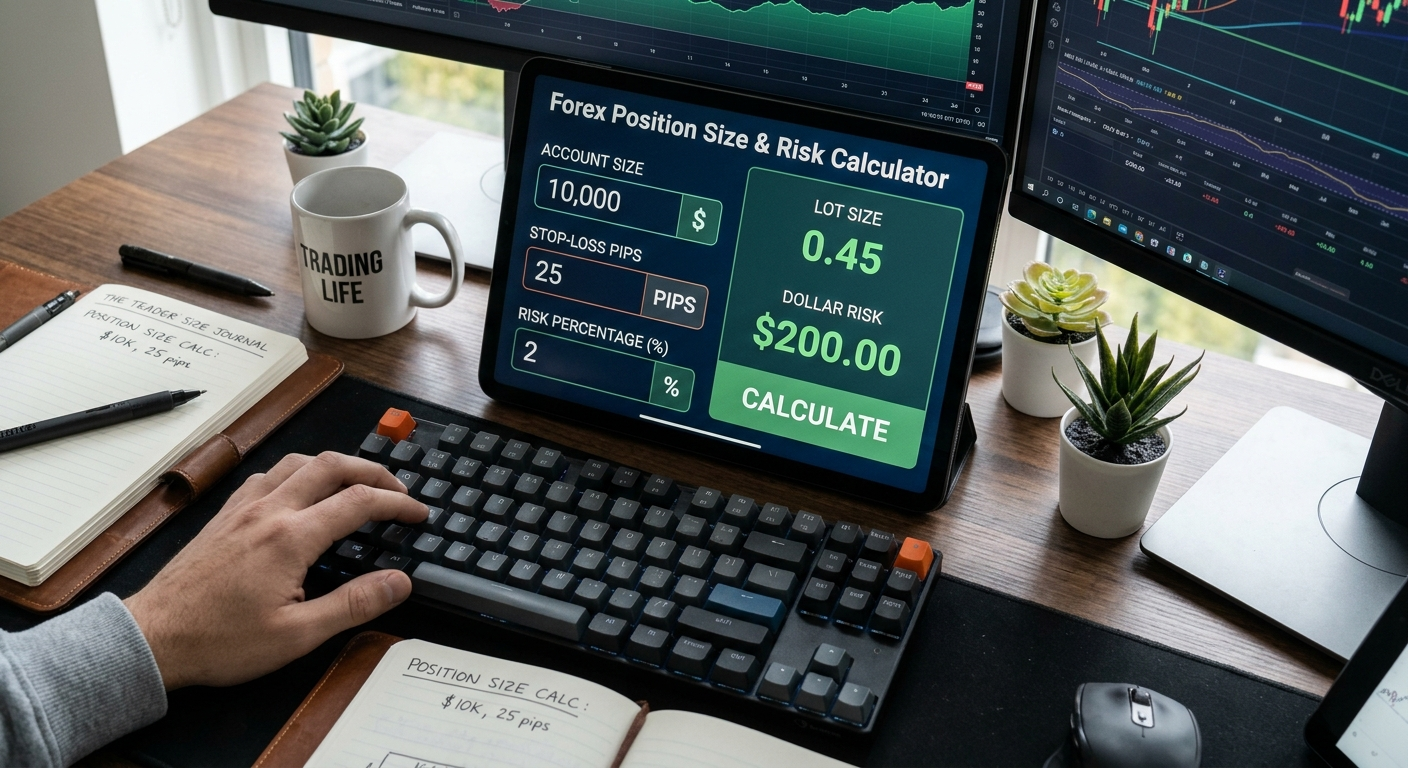
- Calculate your position size for every trade. Use this formula: lot size = account risk in money ÷ (stop-loss in pips × pip value per standard lot). A pip is the smallest standard price move in a currency pair — on EUR/USD one pip equals $10 per standard lot.
Example: $100,000 account, risking 1% ($1,000), stop-loss of 50 pips on EUR/USD.
Lot size = $1,000 ÷ (50 × $10) = $1,000 ÷ $500 = 2.0 standard lots.
Run this calculation every time — or use a position size calculator to avoid arithmetic errors. Common mistake: copying a fixed lot size across pairs with different pip values. - Set a personal daily loss cap at roughly one-third of the firm’s daily loss limit. If the prop firm drawdown rules allow a $5,000 daily loss, stop trading after losing $1,650 in a day. This buffer means one bad session cannot end your challenge. Common mistake: revenge-trading after two losses and hitting the limit in a single morning.
- Trade only during your best-performing session. Skip days with thin liquidity, major holidays or high-impact releases like Non-Farm Payrolls unless your plan specifically accounts for news volatility. Fewer but higher-quality trades protect your drawdown.
- Log every trade in a journal and review weekly. Record the setup, entry, stop, target, result and a one-sentence note on execution. Each week, check your win rate and average reward-to-risk. Adjust position size or trade frequency if needed — but never abandon the plan mid-challenge. Common mistake: skipping the journal when winning, then having no data to diagnose a losing streak.
- After reaching the profit target, stop trading or reduce to minimal size. The challenge only requires you to hit the target without breaching drawdown. Extra trades add risk with no extra reward. If your firm’s rules require you to stay active, trade the smallest allowed lot size until the evaluation period closes. Common mistake: giving back profits by “pushing for a bigger buffer.”
How to Size Your Trades So You Never Blow the Drawdown Limit
Size every trade so that a single loss never eats more than a small, fixed percentage of your account — this is the core of position sizing for a funded account. The formula in plain English:
Lot size = Dollar risk ÷ (Stop-loss in pips × Pip value per lot)
Dollar risk is the maximum money you are willing to lose on one trade. You get it by multiplying your account balance by your chosen risk percentage. Stop-loss in pips is the distance from your entry price to your stop-loss order — the point where the trade closes automatically if it moves against you. Pip value per lot is how much one pip is worth for one standard lot of the pair you are trading. For EUR/USD, one pip on a standard lot equals roughly $10.
Example: You have a $100,000 challenge account and risk 1% per trade ($1,000). Your stop-loss is 50 pips on EUR/USD. Lot size = $1,000 ÷ (50 × $10) = $1,000 ÷ $500 = 2.0 standard lots.
| Stop-Loss (pips) | Risk % / $ Risk | Pip Value per Lot | Lot Size |
|---|---|---|---|
| 30 | 1% / $1,000 | $10 | 3.33 lots |
| 50 | 1% / $1,000 | $10 | 2.00 lots |
| 80 | 1% / $1,000 | $10 | 1.25 lots |
Notice the pattern: the wider your stop, the smaller your lot size must be. A wider stop gives the trade more room to breathe, but only if you shrink the position. This keeps every loss the same dollar amount, which protects your drawdown cushion steadily across trades.
Common mistake: trading a fixed lot size — say, 2.0 lots — regardless of stop distance. On a 30-pip stop that risks $600, but on an 80-pip stop it risks $1,600. That uneven risk means one bad trade with a wide stop can breach the daily loss limit prop firm rules impose and end the challenge instantly.
Use a position size calculator before every entry so the math is automatic and error-free.
What Are the Biggest Mistakes That Fail Prop Firm Challenges?
The fastest way to fail a prop firm challenge is not a bad strategy — it is abandoning your rules under pressure. Below are the five most common mistakes and exactly why each one leads to a breach.
- Revenge trading after a losing day. You take an unplanned second or third trade to “win back” the loss, and the combined losses break the daily loss limit — a fixed maximum you can lose in a single day, often set around 4–5% of the starting balance. One bad day becomes your last day.
- Moving your stop-loss further away mid-trade. A stop-loss is the price level where your broker automatically closes the trade to cap your loss. Widening it while a trade is open inflates your real risk far beyond the 1–2% you planned, and a single move against you can eat several days’ worth of allowable drawdown.
- Over-trading near the deadline to chase the profit target. With days left and the target still ahead, traders double their frequency or lot size. This abandons the trading plan that kept the account alive and turns the evaluation into a coin flip.
- Ignoring firm-specific restricted-trading rules. Some firms prohibit holding trades through high-impact news releases or over weekends. A trade held through a rule you did not read can be invalidated or count as a violation even if it was profitable.
- Risking more than 2% of the account on a single trade. Traders assume bigger position sizes will reach the target faster. In reality, two or three consecutive losers at 3–5% risk each can breach the overall drawdown limit — the maximum total loss allowed across the entire challenge — before you get a chance to recover.
Notice the pattern: every mistake is a risk-management failure, not a bad market read. Solid position sizing before each trade removes most of these errors because it forces you to define your risk in advance.
A Daily Checklist to Stay on Track During the Evaluation
A daily checklist keeps you disciplined when the pressure of a prop firm challenge tempts you to improvise. Copy or print the three-part routine below and run through it every trading day.
Pre-Session (before you open a chart)
- Check your account balance and calculate the remaining drawdown buffer—the gap between your current equity and the maximum drawdown floor. This is the total loss you can still absorb before failing.
- Open the economic calendar. Mark any high-impact news events (interest-rate decisions, NFP, CPI). Decide in advance whether you will sit those out.
- Re-read your trading plan: which pairs, which setups, what risk per trade, and how many trades maximum today.
During the Session
- Before every entry, run your lot size through a position size calculator to confirm it matches your planned risk percentage—never estimate by eye.
- Place a hard stop-loss before or at the moment you enter. No “mental stops.”
- Cap yourself at a pre-set maximum number of trades per day (for example, two or three). Once you hit that number, close the platform.
- If you hit your daily loss limit—the maximum you are willing to lose in one session—stop immediately, regardless of remaining setups.
Post-Session (after every trading day)
- Log each trade: entry, exit, stop distance, lot size, result, and the setup name from your plan.
- Recalculate your new drawdown cushion so tomorrow’s pre-session step takes seconds.
- Rate your emotional state (calm, frustrated, revenge-minded). If you notice tilt two days in a row, take the next day off.
Weekly Review
- Compare actual risk per trade against your plan. Flag any trade where risk exceeded the target.
- Count wins, losses, and average risk-to-reward. Decide whether to keep the same trade frequency or reduce size until consistency improves.
After You Pass: What Happens With a Funded Account?
Once you pass both phases of the evaluation, the firm issues you a funded account—a live or simulated-live account where you trade the firm’s capital and keep a share of the profits.
Profit split means the percentage of net profit you keep versus what the firm keeps. A common arrangement is 80% to the trader and 20% to the firm, but this varies widely.
A funded account still has drawdown rules. Drawdown is the maximum your account balance can drop before the firm revokes it. These limits work the same way they did during the challenge: a daily loss limit and an overall maximum drawdown. Passing the challenge does not remove risk limits—it simply means you proved you can trade within them.
Key things that typically apply to funded accounts:
- Drawdown rules remain active. Breach them and you lose the account, even after funding.
- Scaling plans may let you trade a larger account over time if you hit consistent profit targets.
- Challenge fee refunds. Some firms refund the evaluation fee with your first profit payout.
The most common mistake after getting funded is relaxing discipline. Traders celebrate, increase lot sizes, skip their checklist, and breach the funded-account drawdown within days. The same prop firm drawdown rules that applied during the evaluation still apply—treat the funded phase with the same care.
Funded does not mean risk-free. You can still lose the account. Stick to the position sizing and daily routine that got you through the challenge.
Is a Prop Firm Challenge Worth the Fee?
A prop firm challenge is worth considering only if the fee is money you can genuinely afford to lose and you already have a proven, profitable strategy on a demo or small live account.
The core value proposition is straightforward: you pay a one-time fee for the chance to trade a funded account that is far larger than what most retail traders — especially those in Nigeria — could deposit themselves. If you pass, you keep a percentage of the profits you generate on that larger capital. That leverage on your skill is the entire appeal.
But here is the other side. Most traders who attempt a challenge fail and lose their fee entirely. The fee is non-refundable in most cases, and many traders pay it multiple times before passing — or never pass at all. That makes the true cost much higher than a single entry fee.
Before paying for a challenge, weigh the alternatives:
- Trade a small personal live account first. Even $50–$200 of real capital teaches you about emotions, slippage, and execution in a way demo trading cannot. It also builds a genuine track record you can review honestly.
- Paper-trade your exact challenge plan. Run it on demo under the same rules — profit target, daily loss limit, and maximum drawdown — for at least 30 trading days. If you cannot pass your own simulation, paying a fee will not change the outcome.
A simple cost-benefit check:
| Question | If “No,” wait |
|---|---|
| Do I have at least 3 months of consistently profitable results? | Keep practising on demo or a small live account |
| Can I lose this fee and still cover my bills? | Never use rent or essential savings |
| Do I fully understand the prop firm drawdown rules for this specific challenge? | Read every rule first — check our prop firm guides for breakdowns |
Never treat a challenge fee as an investment that “should” pay off. Treat it as tuition that you may lose. If that reframe makes the fee feel too expensive, it is too expensive right now.
Frequently asked questions
How many days does it usually take to pass a prop firm challenge?
There is no fixed number. It depends on your strategy, risk per trade and the profit target. Risking 1% per trade and averaging a 2:1 reward-to-risk, reaching an 8% target could take 20 or more trading days. Rushing to finish faster usually means oversized positions, which is the fastest path to breaching drawdown rules.
Can I use an EA or automated strategy during a prop firm evaluation?
Some firms allow expert advisors and some prohibit them or restrict certain EA types such as high-frequency scalpers or copy-trade bots. Rules differ by provider and change frequently. Always check the specific firm’s terms before you start. Using a banned EA can void a passing result even after you have met the profit target.
What happens if I break the daily loss limit by just one dollar?
The challenge ends immediately. Most firms enforce the daily loss limit as a hard rule with no tolerance. Losing even one dollar past the threshold counts as a breach. This is why the article recommends setting a personal daily cap at roughly one-third of the firm’s limit, giving yourself a safety buffer every session.
Do I get my challenge fee back after I pass?
It depends on the firm. Some refund the fee with your first profit withdrawal from the funded account, some roll it into a discounted retry, and others keep it entirely. Never assume a refund. Read the firm’s refund policy before you pay so the fee fits your budget even if it is non-refundable.
Risk warning: Forex and CFD trading carries a high risk of losing money and is not suitable for everyone. This article is for education only and is not financial advice. Never trade money you cannot afford to lose.