Quick answer
- Use 0.01 to 0.03 lots (micro lots) on a $100 account to keep risk at 1–2% per trade.
- Calculate lot size with the formula: Risk in dollars ÷ (stop-loss pips × pip value per micro lot).
- Never choose your lot size based on maximum leverage—always start from your dollar risk budget and stop-loss distance.
In this article
- What is a lot size and why does it matter on a small account?
- How much should you risk per trade on $100?
- How to calculate the right lot size step by step
- Quick-reference lot size table for a $100 account
- Common mistakes that blow a $100 account
- Choosing a broker and account type for small deposits
- Checklist before every trade on a $100 account
- Frequently asked questions
What is a lot size and why does it matter on a small account?
A lot size is the number of currency units you buy or sell in a single trade, and it directly controls how much money you gain or lose per pip of price movement. A pip is the smallest standard price change in a forex pair—for EUR/USD it is 0.0001, or one-hundredth of a cent per unit.
Forex brokers bundle currency units into lots. Here are the four common sizes and their approximate dollar-per-pip values on EUR/USD:
| Lot type | Units | ≈ Value per pip (EUR/USD) |
|---|---|---|
| Standard | 100,000 | $10.00 |
| Mini | 10,000 | $1.00 |
| Micro | 1,000 | $0.10 |
| Nano | 100 | $0.01 |
Look at that table through the lens of a $100 account. A standard lot needs roughly $1,000 in margin at 100:1 leverage—ten times your entire balance, so it is impossible to open. A mini lot at $1 per pip sounds small, but a 50-pip loss wipes out half your account in one trade. That is why the micro lot (0.01 on most platforms) is the best lot size for beginners working with $100.
Lot size matters because it is the single biggest lever on your risk. A 30-pip stop loss costs $3 at 0.01 lots, $30 at 0.1 lots, and $300 at 1.0 lots—same market move, wildly different damage. On a small account, the margin for error is razor-thin.
Main risk: choosing a lot size that is too large turns a normal adverse move into a margin call—the point where your broker closes your trade because your account no longer has enough funds to keep it open.
Common mistake: beginners pick a lot size based on what the broker allows rather than what the account can safely handle. Just because you can open 0.05 lots does not mean you should. Always calculate lot size from your risk budget first. A pip value calculator helps you confirm the dollar cost per pip before you click “buy” or “sell.”
How much should you risk per trade on $100?
You should risk no more than 1–2% of your account balance on any single trade. This guideline, called the 1–2% rule, is the foundation of risk management for a $100 forex account. On a $100 balance, 1% equals $1 and 2% equals $2—that is the maximum you allow yourself to lose if the trade hits your stop-loss.
A stop-loss is an order that automatically closes your trade at a set price to cap your loss. The 1–2% rule works by tying that maximum loss to a small slice of your capital, so no single bad trade can seriously damage your account.
Why so small? Because losing streaks happen to every trader. The rule keeps you in the game long enough to learn and improve. Even ten consecutive losses at 2% risk only cost about 18% of your account—painful, but recoverable. A trader risking 10% per trade ($10) loses roughly half the account after just five bad trades.
Example: account drawdown at different risk levels after consecutive losses
| Consecutive losses | 1% risk | 2% risk | 5% risk | 10% risk |
|---|---|---|---|---|
| 0 | $100.00 | $100.00 | $100.00 | $100.00 |
| 5 | $95.10 | $90.39 | $77.38 | $59.05 |
| 10 | $90.44 | $81.71 | $59.87 | $34.87 |
Each row compounds the loss: after each losing trade the next risk amount is recalculated on the smaller balance (e.g., $100 × 0.99 × 0.99 … for 1% risk). At 10% risk, ten losses leave you with roughly $35—a 65% drawdown that requires an 186% gain just to break even.
The most common mistake is abandoning the rule on “high-confidence” setups. No setup is certain. One oversized trade can erase weeks of careful progress. Decide your risk percentage before you analyse the chart, and never increase it because a trade “feels” right. Use a risk-to-reward calculator to confirm the trade is worth taking at your fixed risk level.
How to calculate the right lot size step by step
Calculating the right lot size before every trade protects your $100 account from oversized losses. The process takes five steps and about 30 seconds once you learn the formula.
- Set your risk in dollars. Pick a percentage of your balance to risk on one trade. At 1%, that is $1 on a $100 account. A risk percentage is simply the share of your total balance you are willing to lose if the trade hits your stop loss.
- Decide your stop-loss distance in pips. A pip is the smallest standard price move in a currency pair — 0.0001 for most pairs. Your stop loss comes from your chart setup, not from a random number. For example, you might place it 30 pips away.
- Find the pip value for one micro lot of your pair. A micro lot is 1,000 units of the base currency (0.01 lots). On EUR/USD, one micro lot has a pip value of roughly $0.10. Other pairs differ, so always check.
- Apply the formula. Lot size = Risk in dollars ÷ (Stop-loss in pips × Pip value per micro lot). The result is in micro lots; divide by 100 to get standard-lot notation for your platform.
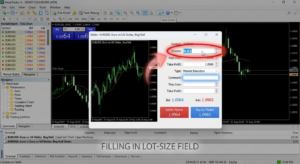
- Enter the lot size in your platform before clicking buy or sell. Never place the order first and adjust later.
Example 1 — EUR/USD, 30-pip stop: $1 ÷ (30 × $0.10) = 3.33 micro lots. Round down to 3 micro lots, which is 0.03 lots on your platform. Your maximum loss is 30 × $0.10 × 3 = $0.90.
Example 2 — GBP/JPY, 50-pip stop: Assume the pip value for one micro lot is roughly $0.09. $1 ÷ (50 × $0.09) = 2.22 micro lots. Round down to 2 micro lots, or 0.02 lots. Maximum loss: 50 × $0.09 × 2 = $0.90.
A free lot size calculator can double-check your arithmetic in seconds — use it every time, especially when you switch pairs.
Common mistake: using the same lot size when your stop-loss distance changes. A wider stop means each pip still costs money, so you need a smaller lot size to keep the dollar risk the same. Always re-run the formula when your stop loss moves.
Quick-reference lot size table for a $100 account
This table gives you pre-calculated lot sizes for a $100 account trading EUR/USD, where one micro lot (0.01) equals roughly $0.10 per pip. Bookmark it and check it before every trade.
| Stop-Loss (pips) | Risk at 1% ($1.00) | Lot Size at 1% | Risk at 2% ($2.00) | Lot Size at 2% |
|---|---|---|---|---|
| 10 | $1.00 | 0.10 | $2.00 | 0.20 |
| 20 | $1.00 | 0.05 | $2.00 | 0.10 |
| 30 | $1.00 | 0.03 | $2.00 | 0.07 |
| 50 | $1.00 | 0.02 | $2.00 | 0.04 |
| 100 | $1.00 | 0.01 | $2.00 | 0.02 |
Example: You set a 30-pip stop-loss and want to risk 2% ($2.00). Divide $2.00 by 30 pips = $0.0667 per pip. Each micro lot is $0.10/pip, so $0.0667 ÷ $0.10 = 0.667 micro lots. Round down to 0.06 or, if your broker allows only one-decimal increments, 0.07. The table rounds to the nearest practical micro lot size for small accounts.
Pip values change with the pair. The numbers above assume EUR/USD. JPY pairs (like USD/JPY) and cross-currency pairs (like GBP/AUD) have different pip values that shift with exchange rates. Always recalculate when you switch pairs. A pip value calculator does this in seconds and removes guesswork.
Account for commissions. This table assumes zero commission. If your broker charges a commission per lot, subtract that cost from your risk budget before choosing your lot size. For instance, if the commission on your trade is $0.14, your usable risk at 1% drops from $1.00 to $0.86, and the lot size must shrink accordingly.
Common mistakes that blow a $100 account
Most $100 accounts are destroyed not by bad market calls but by preventable mistakes in how the trader sizes and manages positions.
Mistake 1: Over-leveraging. Leverage lets you control a larger position than your deposit alone could cover. For example, 1:500 leverage on $100 means you could theoretically open a $50,000 position. The problem: a tiny move against you wipes out your margin — the portion of your balance the broker locks as collateral — and triggers a margin call, which forces the broker to close your trade at a loss. Fix: Calculate your lot size from your risk amount and stop-loss distance, not from the maximum leverage available. Leverage is a ceiling, not a target.
Mistake 2: Moving or removing the stop loss. Once you delete or widen your stop loss, the lot-size calculation you did before the trade no longer protects you. A 20-pip stop that becomes a 60-pip stop triples your dollar risk. Fix: Set the stop loss before you enter and do not touch it afterward.
Mistake 3: Stacking correlated trades. Going long EUR/USD and long GBP/USD at the same time roughly doubles your exposure to USD weakness because both pairs tend to move together. Your total risk may jump from 2% to 4% or more. Fix: Before adding a second trade, ask whether the pairs move in the same direction most of the time. If yes, treat them as one combined risk.
Mistake 4: Ignoring spread cost. A spread is the difference between the buy and sell price — essentially your entry fee. If your stop loss is only 10 pips and the spread is 3 pips, 30% of your stop is already consumed before the trade moves in your favour. Fix: Subtract the spread from your stop-loss distance when planning the trade, and avoid pairs with wide spreads relative to your stop.
Mistake 5: Treating $100 as an income source. A $100 account is a learning tool. Risking 2% per trade means risking $2 — that will not pay bills. Trying to force larger returns leads straight back to mistakes 1 through 4. Fix: Use the account to practise disciplined risk management for a $100 forex account, build a track record, and consider scaling up or exploring prop firm challenges once your process is consistent.
Choosing a broker and account type for small deposits
The broker and account type you pick will decide whether you can actually trade the micro lot sizes a $100 account demands. Not every broker supports a 0.01 lot size — some set the minimum at 0.1 lots, which is far too large for safe risk management on a small balance.
A cent account is an account type where your $100 is displayed as 10,000 cents. Each “lot” in a cent account represents a much smaller position, letting you trade with even finer control than a standard micro lot. This is useful while you are still learning how to calculate lot size in forex and want to keep real-money risk extremely low.
Trading costs hit small accounts harder. A $7-per-lot commission on a 0.01 micro lot is $0.07 per trade — manageable. But if a broker charges $10 per standard lot and you scale down, or if it widens the spread by 2–3 extra pips, those costs eat a bigger percentage of your $100 than they would on a $10,000 account. Always compare the total cost per trade at the 0.01 lot level.
Regulation matters. For Nigerian traders, confirm whether the broker is registered with the Securities and Exchange Commission (SEC) Nigeria and whether it complies with Central Bank of Nigeria (CBN) guidelines for over-the-counter derivatives.
Use this checklist before funding any account:
- Minimum lot size — Does the broker offer 0.01 lots or smaller (cent accounts)?
- Spread + commission — What is the total cost per 0.01 lot on the pairs you trade?
- Regulation — Is the broker regulated, and by which authority?
- Deposit and withdrawal methods — Are local options available, and what are the fees?
- Leverage offered — High leverage is available but increases risk; confirm you can set it lower if needed.
- Demo or cent account — Can you test execution and spreads before risking real money?
The most common mistake is choosing a broker solely because it accepts a low minimum deposit. A $1 minimum means nothing if the broker is unregulated, widens spreads during news, or makes withdrawals difficult. Check our broker reviews before committing funds.
Checklist before every trade on a $100 account
Run through this checklist before you click “buy” or “sell” so that one bad trade cannot wipe out your small account. Save or screenshot the list and review it every single time.
| ✓ | Check |
|---|---|
| ☐ | Risk is 1–2 % of the account. On a $100 balance that means you are risking $1 to $2 on this trade—no more. |
| ☐ | Stop-loss is set by the chart. Place it at a logical level (below support, above resistance, beyond a swing high/low). Never pick a round number of pips just because it “feels right.” |
| ☐ | Lot size is calculated, not guessed. Use the formula: Lot size = Risk in dollars ÷ (Stop-loss in pips × Pip value per lot). Then double-check the result with a position size calculator. |
| ☐ | Spread and commission are included. Subtract the cost of the spread (and any per-lot commission) from your stop-loss budget before finalising the lot size. On a micro lot size for a small account, even a 2-pip spread eats a meaningful share of a tight stop. |
| ☐ | No hidden double exposure. Check whether you already have an open trade on a correlated pair. For example, buying both EUR/USD and GBP/USD at the same time roughly doubles your dollar risk because these pairs often move together. |
| ☐ | Leverage is appropriate. Confirm your position size does not require margin that leaves zero breathing room. A margin call can close your trade before your stop-loss is even reached. |
If any single box stays unchecked, do not take the trade. Risk management for a $100 forex account is not optional—it is the only thing that keeps you in the game long enough to improve.
Frequently asked questions
Can I trade forex with $100 and actually make money?
Yes, but treat $100 as a learning account, not an income source. Risking 1–2% per trade means you risk $1–$2 per position. Gains will be small in dollar terms. The real value is building disciplined habits and a track record before scaling up. The main risk is forcing oversized trades to chase bigger returns.
What happens if I use a standard lot on a $100 account?
A standard lot on EUR/USD requires roughly $1,000 in margin at 100:1 leverage—ten times your $100 balance—so most brokers will not let you open it. Even if they did, a single 10-pip move against you would cost $100, wiping out your entire account instantly.
Is 0.01 lot size good for a $100 account?
Yes. A 0.01 lot (one micro lot) on EUR/USD costs about $0.10 per pip. With a 30-pip stop loss your maximum loss is $3, which is 3% of $100. For tighter risk at 1%, you would still use 0.01 lots but with a stop loss no wider than 10 pips. Always recalculate when changing pairs.
How many pips can I lose before I get a margin call on $100?
It depends on your lot size. At 0.01 lots on EUR/USD ($0.10 per pip), a 1,000-pip move would cost $100—your full balance. At 0.10 lots ($1 per pip), only 100 pips wipes the account. The risk is that wider lot sizes dramatically shrink the distance to a margin call. Always set a stop loss well before that point.
Risk warning: Forex and CFD trading carries a high risk of losing money and is not suitable for everyone. This article is for education only and is not financial advice. Never trade money you cannot afford to lose.